Every time an employee uses a large language model (LLM), there are opportunities for something to go wrong.
Sensitive data can escape in a prompt. Malicious instructions can arrive in a document the model was asked to summarize. A response can surface information originating from retrieved context, connected enterprise systems, or training data.
LLM firewalls are designed to reduce these risks on the interaction paths they inspect. They do not replace model-supply-chain, identity, endpoint, or training-data controls. In this guide, we’ll cover how LLM firewall tools work, features to look for, and the leading products on the market today.
How does an LLM firewall work?
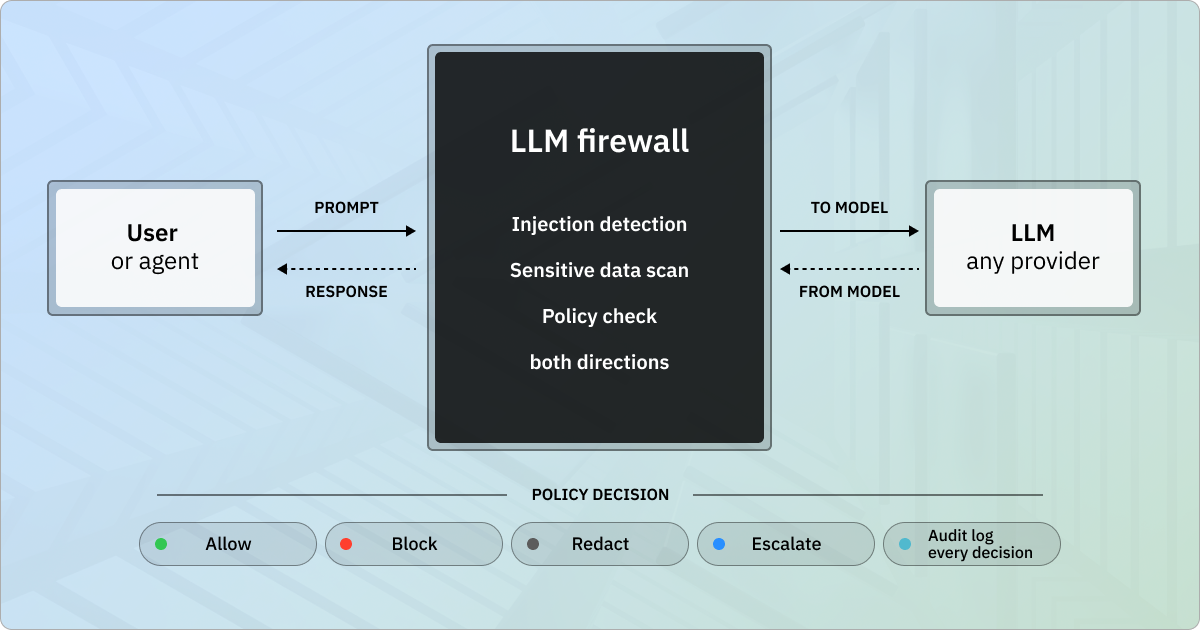
It monitors, filters, validates, and controls both incoming prompts and outgoing responses.
An LLM firewall sits inline between a large language model and whoever (or whatever) is talking to it. It’s essentially the same architectural position as a traditional network or web application firewall, but the traffic is natural language instead of packets. An LLM firewall typically deploys in one of three ways: as a reverse proxy or API gateway in front of the model endpoint, as a software development kit called directly from application code before and after the model call, or as a network-level or service-mesh integration that routes supported requests through an inspection point, sometimes without application-code changes.
On a path configured to use the firewall, each prompt passes through its inspection point first. The firewall runs a set of detectors, usually a combination of heuristic pattern matching, machine learning classifiers, and often, a smaller LLM adapted through additional training that judges the larger model's input. These detectors check for prompt injection, jailbreak attempts, PII, and other sensitive content. Depending on the deployment, the firewall or calling application can allow the prompt through, block it completely, redact parts, or escalate it to a human reviewer.
The same inspection can happen in reverse on the way out. An LLM response can surface PII from retrieved context, connected tools, conversation history, or, in some cases, memorized training data. It can also carry malicious or off-policy content introduced earlier in the workflow. Each firewall decision should be logged with the policy that triggered it, the detector that flagged it, and the action taken.
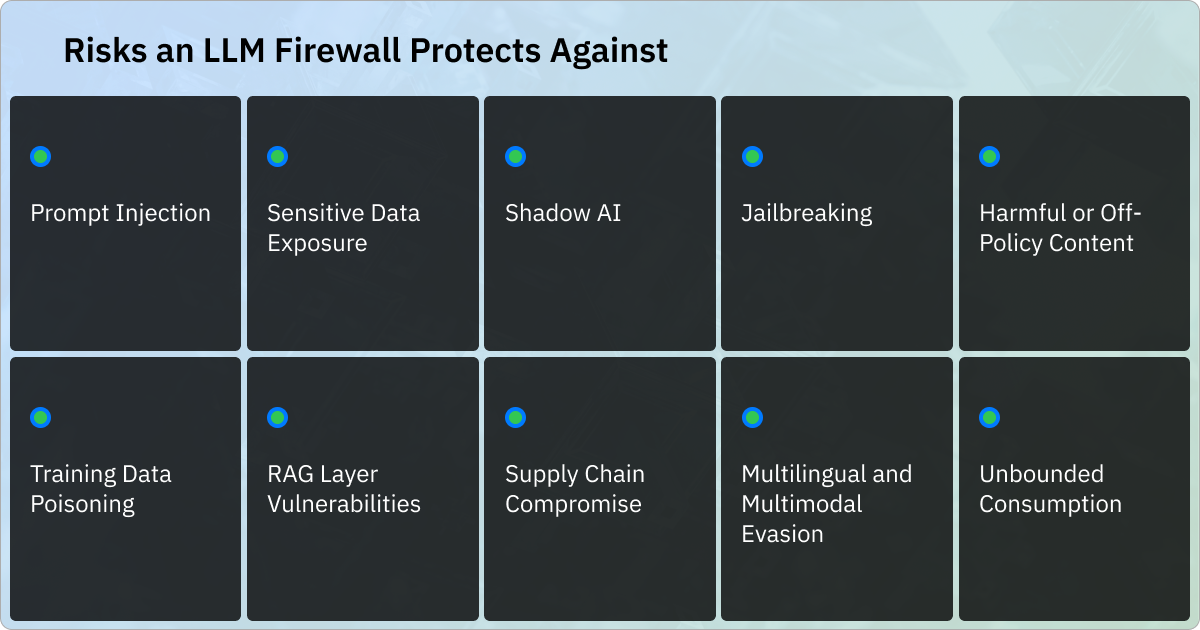
Risks an LLM firewall can help address
Prompt Injection
Prompt injection is ranked #1 on the OWASP list of top LLM vulnerabilities. A 2026 systematic literature review covering 88 studies found that attacks and defenses span direct injection, indirect injection, jailbreaking, and multimodal methods, with reported effectiveness varying by model and attack dataset. Indirect injection through RAG (Retrieval-Augmented Generation) systems is an important attack path because untrusted retrieved content can be interpreted as instructions.
Sensitive Data Exposure
Sensitive data like PII, credentials, or proprietary business information can be entered into a prompt by an employee or surfaced in a model's response from training data, retrieved context, or earlier turns in a conversation. Leaks of proprietary algorithms and confidential details can result in privacy violations and intellectual property breaches.
Shadow AI
Among 600 organizations that had experienced a breach, one in five reported a breach due to shadow AI, according to IBM’s 2025 report. Organizations with high levels of shadow AI had an average of $670,000 in additional breach costs and disproportionately exposed customer PII and intellectual property. Among organizations that reported breaches of AI models or applications, 97% lacked AI access controls. An LLM firewall can help only when the traffic is routed through a governed path; endpoint discovery and access controls are still needed for unmanaged use.
Jailbreaking
A firewall addresses adversarial phrasing, role-play scenarios, encoding tricks, or character-level obfuscation designed to get a model to bypass its safety training and produce content or take actions it was built to refuse.
Harmful or off-policy content
LLMs can produce outputs containing hate speech, violence, or material that violates an organization's brand or usage policy, whether the request that produced it was malicious or simply unanticipated.
Training Data Poisoning
Training data poisoning lets attackers corrupt an LLM at its foundation. By inserting malicious data into training datasets, adversaries can skew model outputs, degrade accuracy, or embed hidden behaviors that activate under specific conditions. A recommendation engine trained on poisoned data might start promoting harmful products without any visible misconfiguration, undermining user trust and creating liability exposure. A runtime LLM firewall does not prevent poisoning of data used for initial or additional model training; addressing the root cause requires dataset integrity, model provenance, scanning, and pre-deployment testing.
RAG Layer Vulnerabilities
Retrieval-Augmented Generation (RAG) is a common architecture for connecting LLMs to enterprise data. It gives models access to internal documents, knowledge bases, and proprietary content. When you connect AI to your proprietary data, you inherit all the responsibilities of safeguarding that data, plus new ones. If the knowledge base is compromised, an LLM’s answers and behavior can be influenced, too. A firewall can inspect retrieved context only when it is integrated into that path; source integrity and access controls remain necessary.
Supply Chain Compromise
The supply chain for a modern LLM application is long and involves multiple external parties. In conventional software, supply chain risk means code flaws and dependency issues. For LLMs, supply chain risk extends to the third-party pre-trained models, datasets used for additional model training, and deployment platforms that organizations depend on but don't fully control. These can be tampered with or poisoned before reaching production. A runtime firewall can limit some unsafe inputs or outputs on monitored paths, but it cannot verify model, dataset, or dependency integrity before deployment.
Multilingual and multimodal evasion
Attacks encoded in non-English languages, character substitution, Base64 or hex encoding, or instructions hidden inside an image processed by a multimodal model can all slip past detectors trained primarily on plain English text.
Unbounded Consumption
Unbounded Consumption occurs when an LLM application allows users to conduct excessive and uncontrolled inferences. This exposes the organization to risks like denial of service, economic losses, model theft, and service degradation. The high computational demands of LLMs, especially in cloud environments, make them vulnerable to resource exploitation and unauthorized usage. OWASP cites this risk as a top 10 security issue. An LLM firewall can help when it includes or integrates with rate limits, quotas, timeouts, or spend controls; not every content firewall provides them.
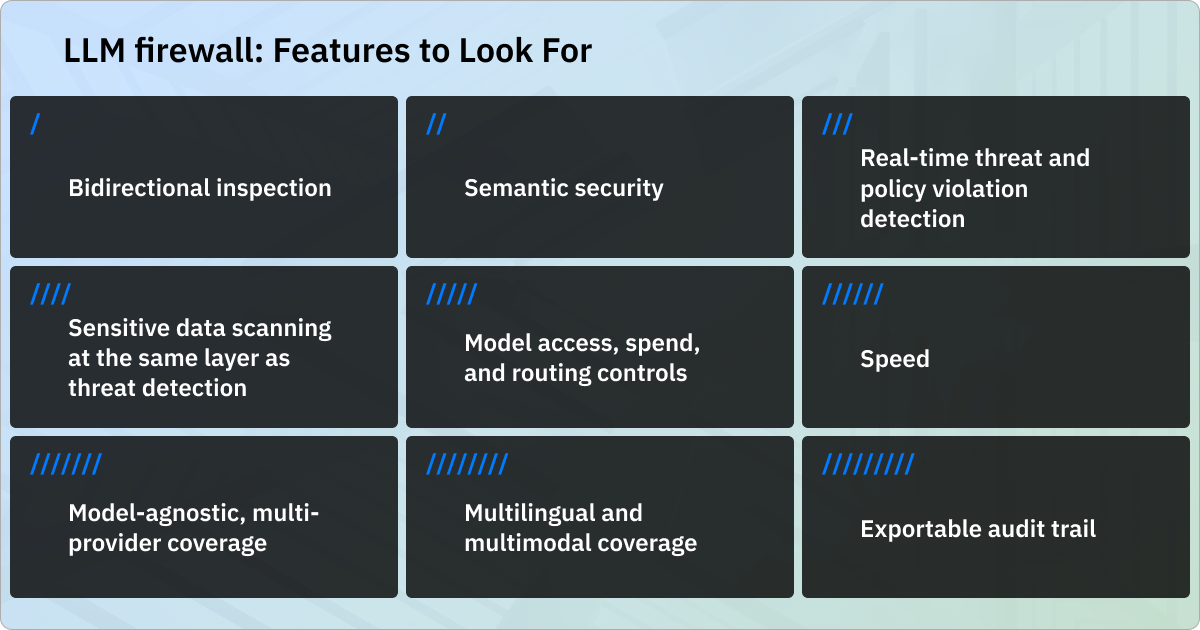
Features to look for in an LLM firewall
Contextual and AI-native security, speed, and audit trails are key capabilities.
LLM firewalls have a narrow and vitally important job. It’s important to make sure the tool you select has the right capabilities. A firewall with weak detection, high latency, or limited provider coverage won’t do much more than provide a false sense of security. Below are some of the features that really matter when you’re evaluating products.
Bidirectional inspection
The firewall needs to check prompts on the way in and responses on the way out, since an attack or a leak can originate from either direction. A tool that only screens one side leaves the other half of every interaction unguarded.
AI-native semantic security
Rather than just scanning for known data patterns, AI-native semantic analysis evaluates the meaning and context of conversational content, identifying sensitive information expressed in natural language that may pass undetected through conventional controls.
Real-time threat and policy violation detection
Beyond prompt injection, the detection layer should cover policy violations specific to the organization, not just the generic threat categories every vendor ships out of the box.
Sensitive data scanning at the same layer as threat detection
PII, secrets, and custom data patterns should be checked alongside prompt injection. Running coordinated controls at the same inspection point can reduce added latency and policy gaps, although organizations may still use separate or parallel detection services.
Model access, spend, and routing controls
A firewall that also functions as a gateway, validating which models a given request is allowed to reach, enforcing spend limits, and applying routing rules, closes the gap between a security control and the cost and access governance most security teams are also responsible for.
Speed
Detection that's accurate but slow can’t match a customer-facing application. Look for documented latency figures under real traffic load, not just lab benchmarks.
Model-agnostic, multi-provider coverage
The firewall should work the same way regardless of which model or provider sits behind it, so policy doesn't fragment every time the organization adds a new model.
Multilingual and multimodal coverage
Detection needs to hold up across languages and, increasingly, across images and other non-text input, not just the English-language text attacks most public benchmarks are built around.
Exportable audit trail
Every decision should generate a record that can support SOC 2 and GDPR assessments and be exported into existing SIEM tooling. This evidence supports an assessment; it does not establish compliance on its own.
Top 5 LLM firewall tools in 2026
Adoption of LLMs has been one of the fastest tech developments in history. The 2026 Stanford AI Index found that organizational AI adoption reached 88%. Separately, generative AI reached 53% population adoption within three years. The result is a security gap. Traditional security tools weren’t designed to deal with the risks created by AI. LLM firewalls can help close one part of that gap by inspecting governed prompt and response traffic. Below, we review the leading LLM firewall tools on the market (in no particular order).
Check Point AI Guardrails (formerly Lakera Guard)
Check Point AI Guardrails, formerly Lakera Guard, operates as a runtime security layer when applications or gateways send interactions through its Guard API. Core capabilities cover direct and indirect prompt injection detection, jailbreak prevention, PII detection and redaction, secrets detection, custom data pattern matching, and content moderation. The calling application or gateway uses the returned result to enforce the configured action.
Check Point says its AI Guardrails detection models draw on a proprietary threat database that grows by roughly 100,000 entries per day, informed partly by Gandalf and more than 80 million adversarial patterns.
Check Point AI Red Teaming, the companion testing product, runs automated attack simulations against LLM applications to surface vulnerabilities before production. Its findings can be used to configure AI Guardrails policies. The runtime platform is API-first, accepting interactions in the OpenAI chat completions message format, and is available as SaaS or a self-hosted product.
Best for: Development teams and enterprises building LLM-powered products that need runtime protection with continuously updated threat intelligence.
First Recon AI
First Recon AI’s approach to LLM security is distinct. Instead of adding an AI control layer, it creates a single governed workspace for security, governance, and productivity. This means that employees access all approved AI providers (ChatGPT, Claude, Gemini, Copilot, and open-weight models) through one secure, governed interface.
First Recon’s AI Security Runtime LLM firewall inspects configured prompts and agent interactions for injection attacks, jailbreaks, and data exfiltration on the governed paths where it is deployed, and scans responses for unsafe content and policy violations on the return path. Policy actions are configurable per detection type: allow, block, redact, or route to human review, and every enforcement decision generates audit-ready evidence.
A key innovation is the Semantic Security Engine, which evaluates the meaning and context of prompts and responses and catches sensitive content in natural language that would normally escape DLP pattern-matching controls. Because the same content can be safe in one context and dangerous in another, First Recon adds the Security Context Graph which connects each prompt to the identity, device, data, destination, policy, and decision history that govern it, before the interaction moves forward.
First Recon AI offers a free 30-day trial for security teams.
Best for: Security teams that need sensitive data intercepted before it reaches an AI model, with bidirectional firewall inspection and policy-linked audit evidence across multiple AI providers.
Cisco AI Defense
Cisco AI Defense can inspect prompts and responses through an AI Defense gateway, Cisco Multicloud Defense, or the AI Defense Inspection API. Coverage applies to the applications and model connections configured to use those enforcement points; it does not automatically apply to every model interaction in an environment.
On protected connections, Cisco can inspect both sides of a model interaction. On the input side, the firewall checks prompts before they reach the model, covering prompt injection, prompt extraction, denial-of-service attempts, and command execution. On the output side, it scans model responses for sensitive information, hallucinations, or harmful content, including sensitive data from additional model training or connected databases used in retrieval-augmented generation. Gateway policies can block responses that fall outside an organization's policy before they reach the user; Inspection API integrations return a result for the application to enforce.
Guardrails are configurable by use case. Because AI models are used across different industries and workflows, the platform lets organizations apply different guardrail profiles to different applications rather than enforcing a single generic policy across all of them. Policies can be enforced via a gateway or called directly from application code through the AI Defense Inspection API, which lets developers build inspection into their own applications when they need more control over how violations are handled. Deployment options include a SaaS data plane and customer-deployed private-cloud or on-premises data planes. In customer-deployed configurations, validation and runtime processing can occur within the customer's environment while the SaaS control plane manages configuration.
Best for: Organizations looking for LLM security that aligns with other Cisco applications.
SentinelOne Prompt Security
SentinelOne Prompt Security, added following SentinelOne's August 2025 agreement to acquire Prompt Security, covers the full range of AI interactions from a single platform: employee AI tool usage, developer code assistants, homegrown AI applications, and autonomous agents. The real-time AI firewall blocks adversarial prompts and scrubs sensitive outputs, with granular, role-based policy controls that let teams redact or tokenize sensitive data on the fly, block high-risk prompts, and deliver inline coaching to users without interrupting workflows.
SentinelOne also offers agent coverage, which extends to MCP server discovery: the platform surfaces shadow MCP servers and unsanctioned agent deployments automatically, enforces least-privilege access so agents operate only within their defined scope, and maintains a searchable audit log of governed agent actions, decisions, and enterprise system interactions. Red-teaming findings convert directly into production guardrails on a shared policy fabric, closing the gap between pre-deployment testing and runtime enforcement.
Best for: Organizations that want firewall protection for built applications paired with visibility into unmanaged employee AI use through supported browser, desktop, and API integrations.
CrowdStrike Falcon Guardian
CrowdStrike Falcon Guardian is CrowdStrike’s current AI Detection and Response (AIDR) product. It incorporates prompt-layer technology from Pangea, which CrowdStrike agreed to acquire in September 2025.
Falcon Guardian covers workforce AI use, endpoint agents, prompts, sensitive data, and runtime actions across supported endpoint, cloud, SaaS, browser, and application paths. It detects direct and indirect prompt injection, jailbreaks, and model manipulation attempts in real time. It also identifies sensitive data in AI interactions and can redact, encrypt, or block it before exposure.
Falcon Guardian discovers workforce AI use and known or shadow AI agents on managed endpoints, linking activity to endpoint and identity context so security teams can assess what AI is deployed and the potential blast radius of a compromise. Its findings stream directly to Falcon Next-Gen SIEM for cross-domain correlation. CrowdStrike currently labels its centralized AI gateway, including MCP traffic coverage, as coming soon.
Best for: Organizations already running CrowdStrike Falcon that want firewall protection correlated with the same identity and endpoint telemetry the rest of the platform already collects.
LLM security that keeps pace
The interaction layer is expanding fast. Prompt-and-response cycles between humans and models are only part of it now. Agents generate their own interactions at machine speed, MCP server connections add tool-call surfaces that don't look like prompts but carry the same injection risk, and multi-agent workflows can propagate an attack across an entire automated pipeline.
Firewalls that are built only for human chat won’t work for the environment most of us will be operating in twelve months from now. The teams that will keep their footing (and make the most of LLM capabilities) are the ones that choose LLM firewall tools that can keep up on the surfaces they govern, analyze meaning and context, and generate policy-linked audit evidence along the way.